Film Slitting Machine Price 5 Key Factors
The price of a film Slitting Machine comes from five main factors. The machine's specs set its speed, width, and automation level. Build quality and parts decide how rigid and reliable it is. Customization and features match the equipment to certain materials and workflows. The manufacturer and after-sales support affect long-term risk and uptime. Market and regulatory conditions change the final film slitting machine price over time. Each section below explains how these cost factors push the price up or down. Readers can then compare quotes for film slitting machines with their own production needs and compare offers with confidence. The goal is a clear view of what each film slitting machine cost includes, not a single number to rank machines by.

Key Takeaways
-
Machine specs like speed, width, and automation level are the biggest things that drive price. Pick specs that match what you actually produce, so you don't pay for capacity you never use.
-
Good build quality and name-brand parts cost more at first. But they make the machine more reliable and lower costs over time. Better blades and frames keep the cuts accurate and save money in the long run.
-
Making the machine fit special materials and work steps costs more. Before you ask for a price, list all the materials you plan to run so the machine matches your job.
-
A manufacturer with a strong reputation and good support adds value. A warranty and fast service lower the risk of downtime and protect your investment.
-
Market conditions like material costs and regulations affect the final price. Think about the total cost of ownership, including blades, waste, and downtime, not just the purchase price.
Machine Specifications Drive Film Slitting Machine Price
Machine specifications make up the biggest part of any film slitting machine price quote. Rated speed, working width, and control sophistication each push cost up in predictable ways. A buyer who understands these cost factors can match equipment to real production needs. This way, they avoid paying extra for capability they never use.
Speed, Width, And Slitting Speed Stability
Rated speed tiers create the first price gap. Standard models run at 200 m/min or 400 m/min, while high-speed models reach 800 m/min. Stable running speed usually sits at 70–80% of rated speed. So a 400 m/min machine gives reliable output near 280–320 m/min. Faster rated speeds need stronger frames, larger motors, and more advanced web-guiding systems. All of these raise the film slitting machine cost.
Working width follows a similar pattern. Narrow machines under 600mm suit label and tape producers, with prices from $5,000 to $12,000. Mid-width units from 1000–1300mm handle BOPP, PET, PE, and laminates for flexible packaging operations, priced between $15,000 and $40,000. Wide machines from 1600–1800mm process jumbo rolls and multi-layer films at $50,000–$90,000. Industrial-scale systems above 2000mm cost more than $90,000.
|
Width Range |
Typical Materials |
Suitable For |
Price Range (USD) |
|---|---|---|---|
|
600mm and below |
Labels, tapes, narrow films |
Small workshops, startups |
$5,000–$12,000 |
|
1000–1300mm |
BOPP, PET, PE, CPP, laminates |
Mid-volume flexible packaging |
$15,000–$40,000 |
|
1600–1800mm |
Jumbo rolls, multi-layer films |
High-volume converting |
$50,000–$90,000 |
|
2000mm |
Specialty wide-web materials |
Industrial-scale production |
$90,000–$150,000 |
Slitting speed stability directly affects product quality and long-term speed consistency. Constant tension control and edge correction (EPC) add cost but protect accuracy. Premium film slitting machines hold slitting tolerance to ±0.1mm with end-face flatness at ≤0.5mm. Segmental tension control improves end-face alignment from ±0.31mm to ±0.14mm while cutting deformation rates from 2.1% to 0.8%. Adaptive feedforward correction reduces high-speed offset by 42% by adjusting roller angle 0.2 seconds in advance.
"Not all films require high precision; blindly unifying high-speed or low-speed is not economical." — an industry engineer
This insight matters because plastic film types differ widely. A standard model fits small-batch work with modest materials. A high-speed unit with better speed stability serves large-scale production where downtime costs outweigh equipment premiums.
Automation Level
Automation tier is the second major specification driver for film slitting equipment. Manual machines use relay-based controls with magnetic particle clutches and need 15–20 minutes per changeover. Semi-automatic units add PLC controls from Delta or Mitsubishi with servo closed-loop tension and motorized knife positioning. This cuts changeover to 5–8 minutes at a 40–60% price premium.
Fully automatic systems use Siemens or Beckhoff PLC/CNC controllers with multi-zone servo tension feedback and laser-guided knife positioning. Changeover drops to 2–3 minutes, but the premium reaches 150–300% over manual baselines. Auto roll change adds roughly 120–130% over a standard slitter yet reduces downtime substantially.
PLC and touch-screen controls sit mid-range in cost. These key features enable recipe storage and smooth and precise speed control without full automation expense. Buyers should weigh changeover frequency against automation costs. A shop running few roll changes gains little from laser-guided positioning.
The right specification balance depends on production needs. A narrow-label startup benefits from a manual or semi-automatic unit. A high-volume converter processing wide webs justifies fully automatic film slitting machines despite higher initial costs.
Build Quality And Components

Frame strength and part quality are the second biggest cost factors in any film slitting machine quote. Buyers who compare film slitting machines by price alone often miss how construction choices affect accuracy and service life. This section shows where build quality raises the film slitting machine price and where it does not.
Frame And Material Construction
A strong, high-rigidity frame helps slitting accuracy and long service life. Heavy-gauge steel frames resist vibration at higher speeds, which protects slitting speed stability and end-face quality. Frame mass and damping also help speed stability during fast acceleration. Precision cutter sets add cost, but they hold tolerance and reduce waste on thin plastic film. These key features set durable film slitting equipment apart from light-duty builds.
Knife grade is a real cost line, not something to ignore. Dull or low-grade blades make dust and ragged edges on plastic film. The table below compares three common blade materials.
|
Property |
D2 Tool Steel |
M2 High-Speed Steel |
Tungsten Carbide |
|---|---|---|---|
|
Typical Hardness |
58–62 HRC |
62–66 HRC |
72–82 HRC |
|
Wear Resistance |
Good |
Excellent |
Exceptional |
|
Impact Toughness |
High |
Medium |
Low |
|
Heat Resistance |
Moderate |
High |
Very High |
|
Cost |
Budget-Friendly |
Mid-Range |
High Investment |
A low-grade D2 knife costs $150 and lasts 100 hours, or $1.50 per hour. A tungsten carbide knife costs $900 and lasts 3,000 hours, or $0.30 per hour. The high-grade blade costs $750 more upfront but runs $1.20 cheaper per hour over time. Blade choice therefore affects both slitting speed stability and running costs.
Branded Parts And Drives
Branded motors, drives, bearings, and PLCs on film slitting machines cost more than generic parts. They also affect reliability and spare-part availability. These mechanical components of the slitting machine determine speed stability and long-term speed consistency. A branded drive holds tension curves more precisely, which supports better speed stability across a long run. That stability protects yield.
Budget builds still fit lower-volume or less demanding film work. A shop with modest production needs gains little from premium drives. Buyers should match mechanical components to real duty cycles. This approach keeps costs aligned with production needs and protects stability where it matters. Careful matching of film slitting machines to the job also preserves stability without overspending.
Customization And Features
Customization raises the film slitting machine price when a buyer needs the equipment to fit a certain mix of materials or a certain workflow. Material adaptability causes much of this cost. A slitting machine for plastic film must handle PET, OPP, PE, PVC, and laminated film. These materials differ in tensile strength and thickness. Each one may need its own tension profile and knife setup. A machine tuned for one plastic film often runs poorly on another. Buyers should list every material type they plan to process before asking for a quote.
Specialized Slitting Methods
Minimum slitting width shapes the price directly. A machine that holds a 10mm minimum width needs finer knife positioning and tighter web control than a unit built for wider strips. Strip count comes from total web width divided by minimum width, so high strip counts multiply the precision demands on the cutter set. These key features protect slitting speed stability across narrow lanes.
Vertical and horizontal configurations carry different cost profiles. The table below sums up the qualitative differences.
|
Cost Aspect |
Horizontal Configuration |
Vertical Configuration |
|---|---|---|
|
Upfront purchase price |
Higher |
Lower |
|
Maintenance cost |
Higher, due to larger size and more complex mechanics |
Lower, with a simpler structure |
|
Manufacturing cost |
Higher |
Lower |
|
Overall buyer price |
Less budget-friendly |
More budget-friendly |
Vertical units suit compact spaces and small-batch work. Horizontal units handle larger widths and heavier rolls. Neither choice is better by itself; fit to production needs decides.
Software And Controls
Software adds cost through recipe storage, tension curves, and inspection integration. Recipe storage lets operators recall settings for each material in seconds. Tension curves hold speed stability across a full run. Inspection integration links defect detection to the slitting line, which supports quality control in plastic film manufacturing and processing. These functions carry real costs, yet they cut waste and rework.
Sanhui Machinery offers customized solutions and training as part of its slitting-machine lineup. Buyers comparing film slitting machines should weigh these software options against actual production needs. A shop running one material gains little from deep recipe libraries. A converter juggling several plastic film grades gains a lot. Matching features to the job keeps the film slitting machine price honest, and it protects stability where the line runs hardest.
Manufacturer And Support For Film Slitting Machines
The company behind a quote shapes the film slitting machine price as much as the steel does. Reputation, warranty, and service terms all add real costs. Buyers who read these lines carefully can see where a higher quote buys lower long-term risk.
Reputation And Track Record
An established manufacturer with a broad model range earns a higher price through consistency and parts availability. Sanhui Machinery, for example, has built its Model 320 to 3500 slitting-machine range since 2014. That span covers narrow label work up to wide-web converting. A long track record means proven mechanical components and spare parts that stay in stock. Buyers comparing film slitting machines should treat a deep model range as a sign of stable supply, not just a catalog number.
Warranty And Service Terms
Warranty terms form a visible price component. A one-year machine warranty with two-year core-component coverage carries a cost that a shorter warranty does not. The maker absorbs repair risk during that window, and that protection shows up in the quote.
Service terms follow the same logic. Round-the-clock technical support, remote guidance, and on-site visits within 48 hours all sit inside the price. So does installation and commissioning in 3–5 days with operator training. These services protect stability during the first production runs, when a slitting machine for plastic film is most at risk from setup errors.
Lower-support sellers may quote less. They also shift risk to the buyer. A cheap film slitting machine without remote help or fast site visits can stall a line for days. Buyers should weigh that exposure against the discount. The right film slitting equipment matches support depth to production needs. A shop running one plastic film grade may accept lighter support. A converter with tight delivery windows should price service into the decision. Either way, the film slitting machines that stay running are the ones backed by a maker who answers quickly.
Market And Regulatory Factors In Film Slitting Machine Price
Market conditions are outside the machine itself, but they still change the film slitting machine price. Steel, electronics, and freight costs shift over time. Lead times and currency exchange matter too. A quote signed this quarter may not hold next quarter, so buyers should check how long a price stays valid.
Supply Chain And Material Costs
Steel and electronics make up most of any film slitting machine build. When steel prices go up, frame and shaft costs follow. When chip supply gets tight, PLC and drive prices rise. Freight adds another layer, and long lead times leave buyers open to currency swings between order and delivery.
Ongoing expenses deserve equal weight. A low initial purchase price can hide high running costs. The table below compares two film slitting machines over five years.
|
Cost Factor |
Machine A (Low Initial Price) |
Machine B (Higher Initial Price) |
|---|---|---|
|
Purchase Price |
$50,000 |
$80,000 |
|
Blade Replacement Cost / Year |
$5,000 (monthly changes) |
$1,500 (biannual changes) |
|
Annual Waste Cost |
$20,000 (at 4% waste) |
$5,000 (at 1% waste) |
|
Annual Downtime Cost |
$15,000 (150 hrs) |
$2,000 (20 hrs) |
|
Estimated 5-Year TCO |
$250,000 |
$167,500 |
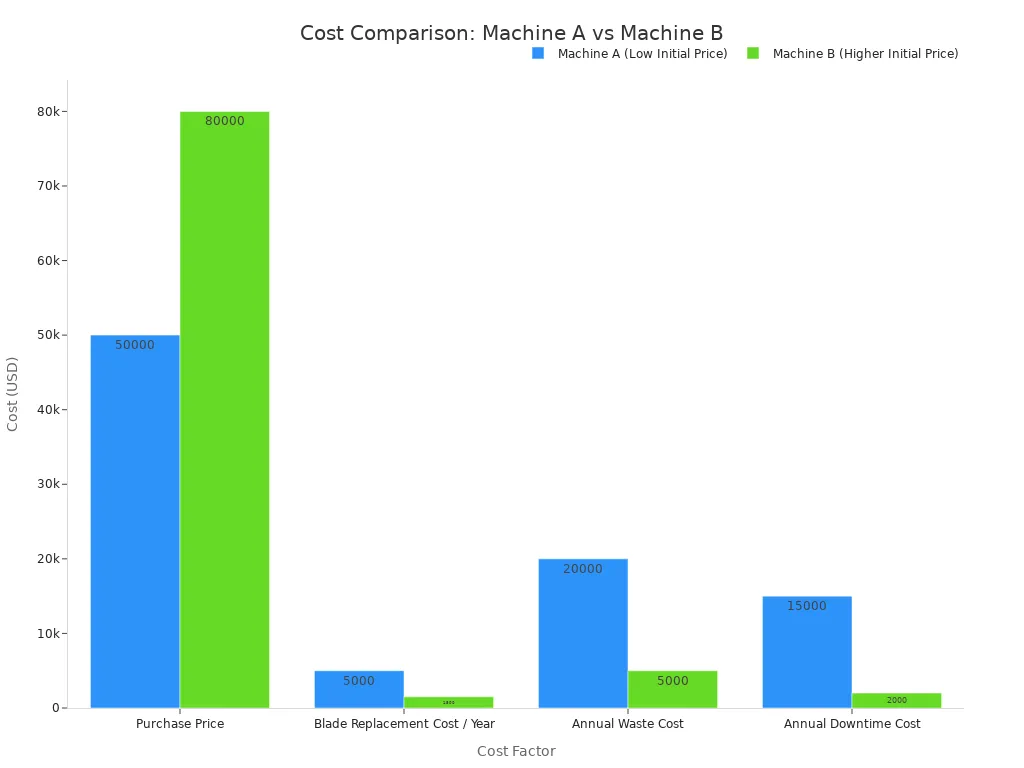
Machine A has the lower initial cost, but its blade spend runs more than triple Machine B's. Over five years the higher-priced unit turns out cheaper overall. Flexible film slitters usually need sharpening every 500–800 operating hours, so blade grade and regrind cycles shape long-run costs as much as the sticker figure does.
Compliance And Certification Costs
Safety and electrical compliance certifications for the destination market add cost. Import duties and local standards affect the landed price too. The table below shows one worked example for a machine with a CIF value near ₹10,59,840.
|
Cost Component |
Basis / Rate |
Amount (INR) |
|---|---|---|
|
CIF value |
FOB USD 12,000 freight USD 600 insurance USD 120 |
10,59,840 |
|
Basic Customs Duty (BCD) |
7.5% of CIF |
79,488 |
|
Social Welfare Surcharge (SWS) |
10% of BCD |
7,949 |
|
IGST |
18% on (CIF BCD SWS) |
2,06,678 |
|
Total landed cost (approx.) |
before local transport/installation |
13,53,955 |
Voltage standards matter as well. A grid rated 415V / 3-phase / 50Hz differs from the 380V build common on Chinese domestic machines. Buyers should state the target voltage in the purchase order so motors, VFDs, and panels match. A 30 kVA automatic voltage regulator costs roughly INR 35,000–55,000 where supply fluctuates beyond ±10%.
Five main factors shape every film slitting machine price quote. Machine specifications set the speed, width, and automation level. Build quality and components decide how rigid and reliable the machine is. Customization and features match the equipment to your material and workflow. Manufacturer support affects risk and uptime. Market conditions move costs over time.
A quoted price reflects a balance of these factors, not a single number for ranking film slitting machines. Buyers should weigh slitting speed stability and long-term speed consistency against their own mix of materials. They should test speed stability on real film grades. They should match key features and production needs to their budget. This approach keeps film slitting machines fit for the job, and it protects stability where the line runs hardest.
FAQ
How much does a film slitting machine cost?
The price depends on width, speed, and automation. Narrow units start near $5,000, while wide industrial systems go over $90,000. A high-speed film slitting machine with full automation sits at the top of that range. Buyers should ask for quotes that match their material mix and output goals.
Which specifications most affect speed stability?
Tension control and edge correction protect speed stability the most. Premium models hold slitting accuracy to ±0.1mm and end-face flatness at ≤0.5mm. Rated speed alone does not promise quality. Stable running speed usually reaches 70–80% of the rated figure, so buyers should test film slitting machines on their own materials.
How much more does auto roll change add?
Auto roll change adds about 120–130% over a standard slitter. The extra cost buys shorter changeovers and less downtime. High-volume converters often get the cost back quickly. Shops with few changeovers gain less. Buyers should think about how often they change rolls before choosing among film slitting machines.
What warranty and support come standard?
Sanhui Machinery gives a one-year machine warranty and two-year core-component coverage. Support includes 24/7 technical help, remote guidance, and on-site visits within 48 hours. Installation and commissioning take 3–5 days with operator training. These terms sit inside the film slitting machine price.
Can one machine handle PET, OPP, and PE?
Yes, with the right tension profiles and knife setups. Each film grade differs in tensile strength and thickness. Buyers should list every material before asking for a quote. Customized film slitting machines then arrive tuned for the full material mix, which protects output quality across runs.