Applying PLC Controls To Industrial Slitting Machine Systems
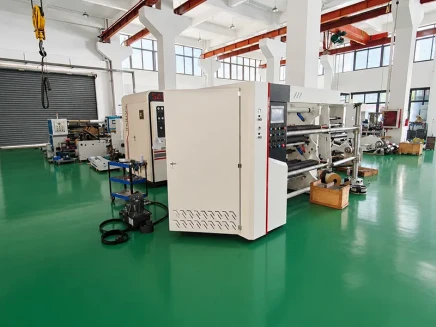
A programmable logic controller acts like a main brain. It works inside your plc controlled Slitting Machine. This control system gathers fast data from many parts. It uses sensors, encoders, and load cells together. The key job of plc software uses fast logic. Through precise plc automation, the drive system manages parts. It controls tension control, knife positioning, and motor synchronization. You easily stop web distortion and material wrinkling. You also stop roller slippage without any problems. Modern industrial automation improves slitting precision and efficiency.
Key Takeaways
-
PLC systems quickly adjust motor torque. They hold exact tension. They prevent material wrinkles.
-
Master-follower drives match motor speeds. Sharp encoders stop material slipping.
-
Servo blade alignment gives high precision. Edge sensors keep rolls straight.
-
Joined safety controls stop motors fast. Built-in alarms spot early faults. They stop downtime.
Tension Control in a PLC Controlled Slitting Machine
Good web tension stops stretching. It prevents wrinkles too. It avoids web breaks. Modern converting lines use a programmable logic controller. It runs fast winding cycles. You gain great stability. The control system changes drive torque fast.
Closed-Loop Load Cell Feedback
Load cells measure material force. They do this continuously. They send electrical signals. Signals go to the main unit. A fast plc processes these values. It uses closed-loop algorithms:
-
Proportional (P): It adjusts output using current error.
-
Integral (I): It adds up past tension errors. This step fixes tiny steady errors.
-
Derivative (D): It predicts future tension trends. This helps speed changes work better.
Sanhui Machinery builds automatic tension controls. They add edge correction devices too. Their equipment setup works well. It stops material deviation. It stops web wrinkling. It stops edge deformation. The responsive machine cuts thin plastic films. It cuts heavy kraft paper. It cuts soft aluminum foil. You get high production efficiency. Material waste stays very low.
Note: Good PID calibration tracks tension smoothly. You avoid dangerous tension spikes during emergency stops.
Brake and Servo Drive Control
Older equipment uses friction brakes. Modern systems use AC servo drives. Fast plc outputs run these drives. You get higher machine responsiveness. You get great precision.
|
Operational Metric |
Traditional Friction/Particle Brake |
Regenerative Servo Drive System |
|---|---|---|
|
Tension Variations |
±10% to ±15% |
±2% to ±5% |
|
Slitting Precision |
±0.2mm to ±0.5mm |
±0.05mm to ±0.1mm |
|
Max Operating Speed |
150 to 250 m/min |
300 to 500 m/min |
|
Speed Adjustment Duration |
10 to 30 seconds |
1 to 3 seconds |
|
Energy Utilization Efficiency |
40% to 55% |
75% to 85% |
|
Machine Reset Time |
15 to 25 minutes |
5 to 10 minutes |
Replacing friction brakes brings big benefits:
-
Substantial Energy Savings: The servo recycles extra energy. It lowers power use by 8,000 kWh. It can save up to 12,000 kWh.
-
Lower Maintenance Expenses: You remove magnetic particle parts. You remove friction parts. Servicing costs drop over 70%.
-
Extended Component Lifespan: Servomotors last 5 to 8 years. They need very little care. You mostly clean air filters.
AC drive systems catch kinetic energy. This happens during deceleration. They send live factory data. This includes tension and roll size. Upgrading gives your plc controlled slitting machine power. This modern control system keeps tension exact. It stays within 1% of target.
Taper Tension Rewind Profiles
Rewinding tight material rolls needs care. A programmable logic controller lowers torque. It tracks growing roll sizes. This stops crushed inner cores. It stops outer roll damage.
The automation system runs math routines:
-
Dynamic Roll Diameter Calculation (per scan step):
-
Find length change:
dL_mm := LineEncoderCount * mmPerPulseLine -
Update full length:
L_mm := L_mm dL_mm -
Find current roll size ($D_{mm}$): $$\text{D_mm} = \sqrt{\text{D_core_mm}^2 \frac{4.0 \times \text{L_mm} \times \text{web_thickness_mm} \times \text{void_factor}}{\pi}}$$
-
-
Linear Taper Factor Calculation ($f_{taper}$):
-
Finds a scale factor. It drops from $1.0$ down to $f_{min}$: $$\text{f_taper} := 1.0 - (1.0 - \text{f_min}) \times \frac{\text{D_mm} - \text{D_core_mm}}{\text{D_finish_mm} - \text{D_core_mm}}$$
-
-
Final Torque Reference Output ($T_{ref}$):
-
Applies the taper factor. It fixes winding torque while fixing core loss: $$\text{T_ref} := \frac{\text{T_setpoint_N} \times \text{f_taper} \times \frac{\text{D_mm}}{1000.0}}{2.0} \text{T_core_loss_Nm}$$
-
Different materials need special torque curves:
|
Profile Type |
Taper Function $f_{taper}(D)$ |
Typical Web Material Application |
|---|---|---|
|
Linear |
$1.0 - (1 - f_{min}) \times \frac{D - D_{core}}{D_{finish} - D_{core}}$ |
Heavy kraft paper, aluminum foil |
|
Constant Tension (Hyperbolic) |
$1.0$ |
Rigid plastic film, label stock |
|
Constant Pressure (Hyperbolic) |
$\frac{D_{core}}{D}$ |
Tissue paper, soft non-woven materials |
|
Exponential |
$\exp(-k \times (D - D_{core}))$ |
Asphalt-saturated webs, roofing felt |
|
User Breakpoint Table |
16-point piecewise linear interpolation |
Custom non-linear web materials |
Pick preset taper curves easily. Use the operator screen interface. The control system updates torque fast. It updates every millisecond. You make neat material rolls. You get great edge alignment every time.
Speed Synchronization with PLC Systems
Keep all motors running at identical surface speeds. A modern plc system manages speed matching smoothly.
Master Drive Architecture
Your slitting machine uses a master-follower drive design. A central control system coordinates motor speeds. The slitter drive acts as primary speed reference. The main control system passes speed commands digitally. This setup ensures exact precision across the line.
|
Motor Axis |
Role in Master Architecture |
Control Mechanism & Synchronization |
Energy & Load Distribution |
|---|---|---|---|
|
Slitter (Main Line) |
Speed Master |
Sets the primary line speed reference across the system |
Consumes energy supplied via the shared DC bus |
|
Unwinder |
Regenerative Axis / Line Synchronized |
Holds web tension by continuously braking against the master |
Feeds regenerated braking energy directly back into the common DC bus for other drives |
|
Rewinders (Stations A & B) |
Follower Drives |
Synchronizes to the master speed adjusted for roll diameter using electronic gearing |
Utilizes load sharing during simultaneous winding and switches seamlessly between torque and speed control |
High-Resolution Encoder Feedback
High-resolution encoders track shaft rotation every millisecond. Sensors send position pulses to the controller. The plc processes incoming frequency pulses quickly. Fast plc automation helps drive equipment adjust speed. This tight loop maintains speed precision easily. You get smooth speed transitions without material slipping.
Accumulator and Dancer Roll Control
Dancer rolls absorb shocks during fast speed shifts. Motion sensors monitor dancer positions continuously. The dancer sends voltage signals to the controller.
Tip: Proper dancer tuning prevents web snaps during fast start-up cycles.
The plc calculates position and corrects speed errors. Advanced plc algorithms compute required motor corrections fast. Modern industrial automation regulates tension and position together. Your production line operates smoothly with top stability.
Precision Blade Alignment by Sanhui Machinery
Servo-Driven Actuator Positioning
Fast speeds need strong parts. Machines need digital accuracy too. Sanhui Machinery puts a programmable logic controller in machines. This setup gives great slitting accuracy. You run machines up to 800m/min. Edge quality stays very good. The control system guides motors well. Roll end flatness reaches ≤0.5mm.
Sanhui Machinery slitting tools hit ±0.1mm accuracy using these parts:
-
Full Servo Drive System: Moves drive parts with total accuracy.
-
High-Sensitivity Web Guiding System: Keeps material lined up all the time.
A strong plc runs motor parts. You type widths on the screen. The plc sets blade spacing fast. Motorized parts move knives to exact spots. This fast alignment increases blade precision. Automatic setup stops human measuring mistakes.
Automatic EPC Edge Correction
Bad alignment makes ruined rolls during fast rewinding. The control system hooks to EPC sensors. Sensors track material edges right now. The plc uses position signals fast. It sends commands to moving parts. This smart automation stops material from slipping off course. It works on clear plastic. It works on thick paperboard.
Pick good sensors based on your material type:
|
Sensor Type |
Transparent Film |
Opaque Paper |
Key Feature / Mechanism |
|---|---|---|---|
|
Ultrasonic Sensor |
Supported (Opaque, Transparent, Ultra-Transparent) |
Supported |
Uses high-frequency sound; ignores light changes; works on airtight rolls. |
|
Photoelectric / Optical Sensor |
Supported (with specific optical setups) |
Supported |
Finds edges using light blocks; needs special light setups for clear films. |
Constant light tracking holds precise size during fast runs. Guiding parts fix small side movements fast. This constant edge tracking keeps rolls neat. Material keeps moving without stopping.
HMI Recipe and Cut Management
Factories need quick material swaps. Sanhui Machinery offers clear HMI touch screens. These screens link to a plc controlled slitting machine. Operators save setup steps for different roll widths. One touch brings up knife spots, speeds, and tension.
Modular cutter sets work with saved steps. This control system cuts downtime. It boosts working output. Smart automation saves operator time during knife changes. The new screen gives full views of cutting. Saved settings speed up daily work. Good plc software gives top accuracy for non-stop work.
Integrated Safety and PLC Diagnostics

Safe Torque Off Implementation
Modern slitting machines keep workers safe. They use special safety features. A safety plc triggers Safe Torque Off fast. It works during emergencies. STO cuts power to motors quickly. The control system stays on. You keep main system power active. Motors will not start unexpectedly.
Safety Alert: STO cuts motor power very fast. You clean jams safely. You do not restart software.
This automation prevents machine damage during stops. You restart production very fast. The system tracks motor positions.
Light Curtains and Interlocks
Light curtains create invisible safety zones. Interlocks lock doors during runs. The primary programmable logic controller checks safety tools.
[Light Curtain / Interlock Triggered]
                  │
                  ▼
   [PLC Safety Circuit Interruption]
                  │
                  ▼
 [Instant STO Trigger & Controlled Braking]
A broken light beam stops blades instantly. The system slows motors down smoothly. This prevents material breaks. Safety features keep workers safe. They maintain high factory output.
Real-Time Telemetry Alarms
Diagnostic software spots faults early. It stops big breakdowns. The control system collects live data. It checks drives and sensors. It monitors web tension continuously. The screen displays fast alerts. This happens when values change.
|
Alarm Severity |
Trigger Condition |
System Action |
|---|---|---|
|
Warning |
Minor tension drift or mild filter clog |
Logs event and alerts operator |
|
Fault |
Excessive web deviation or motor overheating |
Slows system speed automatically |
|
Critical |
Light curtain trip or web break detection |
Executes instant emergency stop |
These smart alarms boost overall production. You fix sensor faults quickly. You keep production running smoothly.
New control systems turn old tools into a plc controlled slitting machine. You get better control through industrial automation. This helps build things fast with high precision. Sanhui Machinery uses great automation to keep speed steady. This setup reduces material waste. Their strong control system guides web tension control well. Fast plc automation helps check machines from far away. Upgrade your line with a plc system today. You will get long-term reliability for your whole machine.
FAQ
How does digital control logic improve tension stability?
Modern plc units read load cell data. They check encoders constantly. The control system fixes motors fast. This action holds tension steady. You avoid wrinkles easily. Web breaks stop. Waste stays low.
Tip: Pick web tension profiles early.
Can automated machinery process both plastic films and heavy paper?
Yes, machines run many materials easily. Smart automation lets you choose profiles. Use the touch screen interface. The system updates torque fast. Knife spots change too. Machines cut thin films cleanly. They cut kraft paper easily. They process aluminum foil well.
What precision levels can you expect from servo-driven blade alignment?
Servo parts reach ±0.1mm accuracy. Edge sensors help too. Roll end flatness reaches ≤0.5mm. This setup stops material deviation. Lines run up to 800m/min safely.
How does smart diagnostic tracking minimize factory downtime?
The system tracks sensor data continuously. Drives send live details too. Alarms show small drifts early. You avoid big breakdowns. Fix problems on the screen. Production runs smoothly without long delays.